

Confidential client
Experience
Italian company operating in the sports footwear sector, with over 1,200 employees and an international presence (name omitted for confidentiality)
Challenge
A booking and management application for sports facilities across Italy (tennis, football, padel, etc.) needed to modernize its JavaScript backend deployed on AWS. Based on an outdated framework, with an insufficient level of security and logic fragmented across numerous AWS Lambdas, layers, API Gateways, and EC2 instances, the system was difficult to maintain and evolve. The client already had an in-house technical team, but targeted support was required to address a complex structural transformation: modernizing the architecture, applying established best practices, and strengthening internal know-how without interrupting service for end users, who would continue using the application throughout the entire migration phase.
Solution
Reeturn joined the client’s team as a direct extension of their organization, acting as a service provider through professionals equipped with expertise aligned to the project scope and holding recognized AWS Developer certifications. The collaboration began in the early analysis and design phases, working side by side with the client’s internal team. The objective was not only to rewrite the backend, but also to share methodologies, architectural decisions, and standards, enabling the team to achieve long-term autonomy.
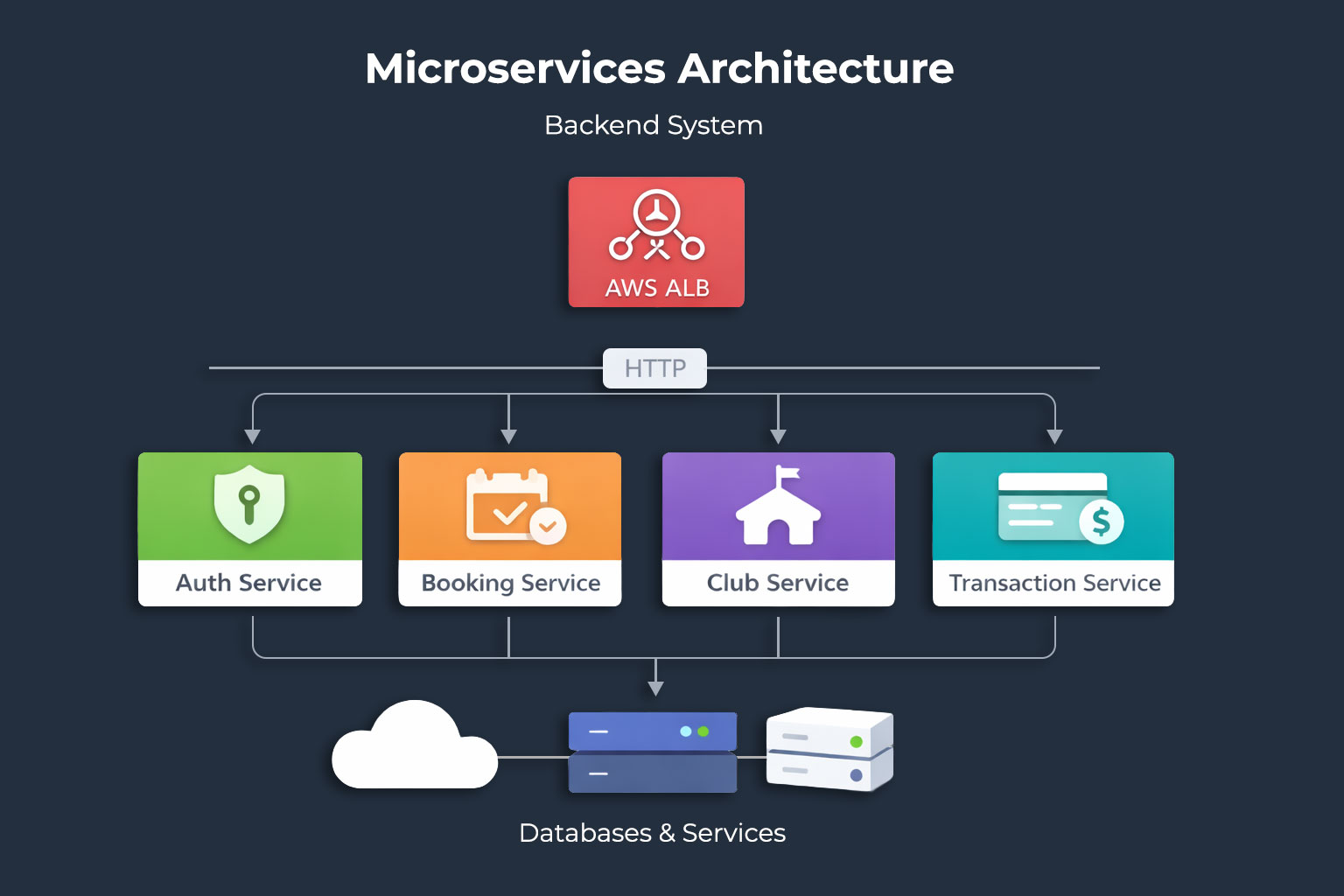
The backend was progressively rewritten in TypeScript, adopting the NestJS framework and a microservices architecture. Logic that had previously been scattered across AWS components and the application backend was consolidated into clear, cohesive services that are easier to understand, test, and extend. In parallel, the AWS infrastructure was streamlined to effectively host the new backend.
For each microservice, a dedicated service was created on ECS, with separate clusters for development, test, and production environments. The same level of separation was applied to critical services (S3, Cognito, SNS, DynamoDB), following an approach that was shared and documented with the client’s team. EKS was deliberately excluded to reduce cognitive overhead and, above all, because ECS is already well suited to hosting software structured around a microservices architecture.
Secrets management was centralized using AWS Secrets Manager, and access to AWS resources was governed through IAM roles configured with the minimum necessary permissions. Each decision was shared and clearly justified, transferring operational expertise directly to the client’s team.
Since the backend would have received exclusively HTTPS traffic with endpoint-based routing, traffic management was handled through an Application Load Balancer, combined with an Auto Scaling Group to automatically manage load and routing rules configured directly on the load balancer.
After careful evaluation, it was decided to implement CI/CD automation to streamline releases (using CodePipeline, CodeBuild, and CodeDeploy) and to manage the automated provisioning of the AWS infrastructure with Terraform, within a project developed and maintained jointly with the client’s team.






Results
Today, the backend is more maintainable, predictable, and robust thanks to strong typing, architectural clarity, and an infrastructure aligned with AWS best practices. Combined with the introduction of dedicated CI/CD pipelines, this has reduced operational overhead and significantly improved time-to-market. Security has also been substantially enhanced: secrets are now managed by AWS with automatic rotation, and both policies and roles have been made significantly more restrictive in accordance with the Principle of Least Privilege.
Monitoring and alerting have also become significantly simpler and more effective, thanks to centralized logic, more structured logs, and the new metrics introduced by the Reeturn team.
The migration was carried out without significant service disruptions thanks to the parallel infrastructure managed through Terraform, and the final transition to the new backend was seamless for end users.
Each operational step was explicitly documented and shared with the client’s developers. Reeturn delivered not only a modern backend and a more resilient architecture, but also a stronger team equipped with solid expertise and a technical foundation ready to grow over time.